
Raising Kids Who Can Recover from Setbacks and Believe in Themselves

Parenting is, at its core, the long game of building inner skills your child can carry when you’re not in the room. You’re not just managing behavior—you’re shaping how they talk to themselves after a mistake, how they try again, and how they treat others (and themselves) along the way. The good news: resilience, independence, and healthy self-image aren’t personality traits your kid either “has” or “doesn’t.” They’re learnable—through daily, repeatable moves.
In a few lines you can actually use
Resilience grows when kids experience manageable challenges and feel supported, not rescued. Independence strengthens when you hand over real responsibility in small doses and tolerate imperfect results. Positive self-image sticks when you praise effort, values, and growth—and when home feels emotionally safe even on hard days.
The “Why is this so hard?” pattern
Problem: Many kids internalize setbacks as identity: “I’m bad at this.” They also learn helplessness if adults step in too quickly.
Solution: Normalize struggle, teach skills explicitly, and give them ownership of age-appropriate tasks.
Result: Over time, kids become more willing to try, more capable of self-correction, and less dependent on constant reassurance.
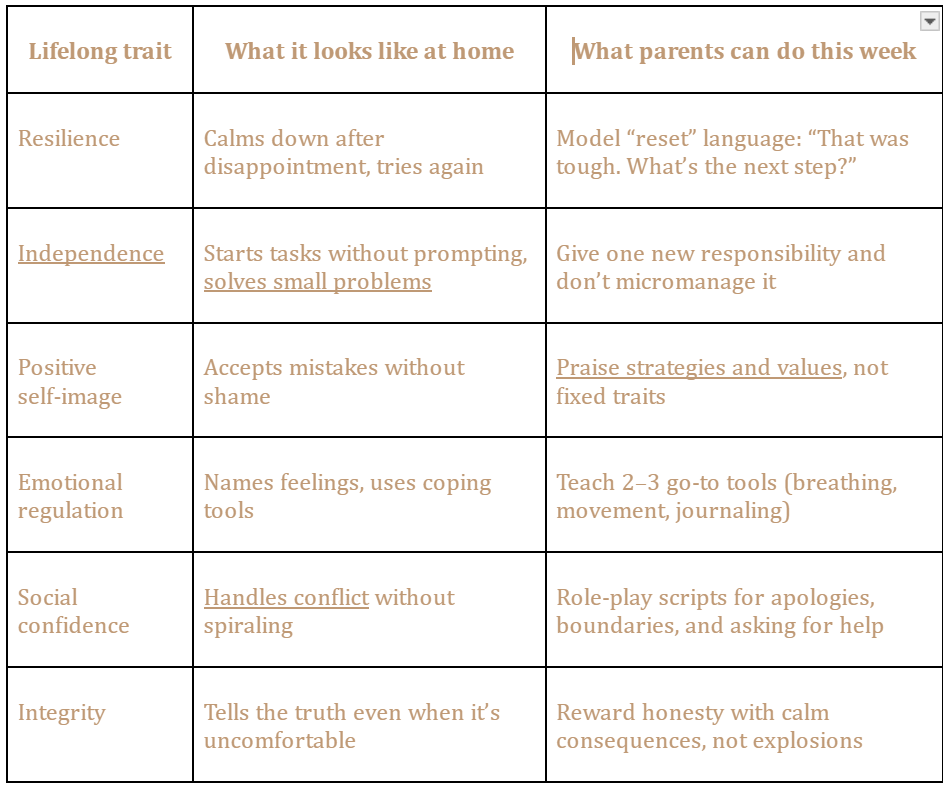
Lifelong traits (and what to do today)
Empowering your teen through entrepreneurship
Entrepreneurship can be a surprisingly effective way to help teens practice real-world problem-solving, decision-making, and responsibility—because outcomes become tangible. A small venture (pet sitting, simple digital products, tutoring, yard care, reselling, or a niche craft) teaches planning, customer communication, time management, and resilience when something doesn’t sell or a client cancels. It also gives them a story about themselves that isn’t based on grades or popularity: “I can build something and learn as I go.” If your teen wants structured help, ZenBusiness is an all-in-one business platform that can support basics like creating a website, registering a business, and designing a logo.
The 10-minute “Resilience Reps” routine
Use this after a rough moment—an argument, a bad grade, a missed goal.
Name the moment (no lecture): “That didn’t go how you wanted.”
Name the feeling: “Frustrated? Embarrassed? Disappointed?”
Separate identity from outcome: “A mistake isn’t a label.”
Find the controllable: “What part can you change next time?”
Choose one small next action: redo one problem, send one message, practice 5 minutes.
Close with belief + autonomy: “I’m here. You’ve got the next step.”
Keep it short. Repetition beats intensity.
One solid outside resource worth keeping bookmarked
When big feelings take over, it helps to have a concrete, trustworthy guide you can return to—especially in the heat of the moment. The American Academy of Pediatrics offers practical, parent-friendly guidance on positive discipline, emotional development, and building healthy behavior patterns over time. Their advice tends to emphasize connection, consistency, and age-appropriate expectations rather than quick fixes.
FAQ
How do I build confidence without creating entitlement?
Focus praise on effort, strategies, and character (“You worked hard,” “You were thoughtful,” “You kept going”) and pair it with responsibility. Confidence grows from competence, and competence grows from practice.
What if my child melts down when things aren’t perfect?
Treat perfectionism as anxiety, not defiance. Teach “good enough” steps, normalize mistakes in your own life, and practice tiny exposures to imperfection (e.g., leaving one small error uncorrected, trying a new activity as a beginner).
How do I encourage independence when it’s faster to do it myself?
Choose one daily task where speed doesn’t matter much and let them own it. Expect it to be messy at first; improvement comes after repetition, not after one perfect attempt.
What’s the best consequence for poor choices?
The best consequence is the one that is calm, related, and teachable. Aim for repair (“How will you make this right?”) and a plan (“What changes next time?”) more than punishment.
Conclusion
Your child doesn’t need a flawless parent; they need a steady one. Small practices—naming feelings, handing over responsibility, and separating mistakes from identity—compound into lifelong resilience. Pick one strategy to start this week and repeat it until it becomes normal in your home. The goal isn’t a “perfect kid”; it’s a capable human.
Written by: Anya Willis
