
Why “Cheap Childcare” Often Becomes the Most Expensive Mistake

There’s a moment many Cincinnati families quietly recognize—but rarely say out loud.
It often starts with a practical decision.
A rate that looks manageable.
A caregiver who is available immediately.
A childcare option that “works for now.”
On paper, it makes sense. In real life, it often becomes something very different.
Not because families are careless—but because the true cost of childcare isn’t always visible at the time of hiring.
For working parents—especially physicians, dual-income households, and families managing demanding schedules—the decision to prioritize affordability over alignment can lead to stress, instability, and ultimately, higher long-term expenses.
This is where the real conversation begins.
The Appeal of “Cheap” Childcare
Every family starts here.
Cincinnati families—whether in Hyde Park, O’Bryonville, Anderson Township, or commuting from surrounding suburbs—often face the same pressures:
Balancing dual incomes
Managing unpredictable work schedules
Navigating waitlists at childcare centers
Coordinating coverage during gaps, transitions, or emergencies
So when a lower-cost childcare option appears, it can feel like relief.
It solves an immediate need.
It reduces monthly expenses.
It provides quick coverage.
But affordability alone rarely tells the full story.
Because childcare is not just a transaction—it’s a daily relationship that directly impacts your child’s environment, your time, and your peace of mind.
What Families Often Don’t See at First
At the beginning, “cheap” childcare may seem sufficient.
The schedule is covered.
The basics are handled.
Your child is safe.
But over time, patterns begin to emerge:
Frequent call-outs or last-minute cancellations
Lack of consistency in routines
Minimal developmental engagement
Limited communication
High turnover or short-term commitment
Individually, these issues may seem manageable.
Together, they create instability.
And instability is where hidden costs begin to accumulate.
The Hidden Costs Add Up Quickly
Cheap childcare rarely stays cheap.
Not because of the hourly rate—but because of what it requires from you.
1. Time Lost to Coordination
Parents end up stepping in:
Covering gaps
Rescheduling meetings
Adjusting work commitments
Managing backup care
Time becomes fragmented.
For physicians and professionals with demanding schedules, this can have ripple effects on productivity and performance.
2. Emotional and Mental Load
When childcare is inconsistent, parents carry constant background stress:
“Will they show up today?”
“Who is watching my child during this gap?”
“What happens if something changes last minute?”
This ongoing mental load is something many families don’t factor into cost—but it’s one of the most significant.
You can read more about this dynamic in The Mental Load of Motherhood in 2025 — And Why Every Mom Needs a Village.
3. Frequent Turnover
Low-cost arrangements often lack long-term commitment.
That means:
Repeated onboarding
Rebuilding trust
Re-establishing routines
Emotional adjustment for children
Each transition carries a cost—not just financially, but developmentally and emotionally.
4. Missed Developmental Opportunities
Quality childcare is not just supervision—it’s engagement.
A well-matched nanny can support:
Language development
Social-emotional growth
Structured play and learning
Age-appropriate routines
When care is inconsistent or disengaged, these opportunities can be reduced or missed entirely.
Learn more about how roles have evolved in The Changing Role of Nannies in Modern Families.
Why Cheap Childcare Often Leads to Expensive Outcomes
Families don’t intentionally choose instability—but short-term decisions can lead to long-term consequences.
Here’s how the math often works:
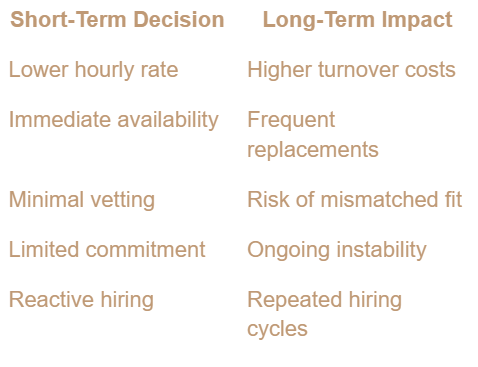
What appears cost-effective initially often becomes more expensive over time due to:
Lost work productivity
Time spent rehiring
Reduced household efficiency
Increased stress
Need for supplemental care
The Cincinnati Context: Why This Matters Locally
In Cincinnati, families are navigating a competitive childcare landscape:
Limited availability of high-quality caregivers
Increasing demand for in-home, personalized care
Growing number of dual-income and physician households
Varied schedules that don’t align with traditional daycare hours
Neighborhoods like Mount Lookout, Kenwood, Blue Ash, and West Chester often include families with complex scheduling needs that require more than standard childcare solutions.
For these households, flexibility and reliability are not luxuries—they’re necessities.
What Quality Childcare Actually Looks Like
When families shift from cost-first thinking to fit-first thinking, the difference is noticeable.
Quality childcare typically includes:
Consistency in schedule and expectations
Clear communication with parents
Engagement with the child’s development
Alignment with family values and routines
Long-term commitment from the caregiver
A well-matched nanny becomes part of the household ecosystem—not just a service provider.
If you’re evaluating what type of caregiver best fits your family, this guide can help:
👉 How to Know What Kind of Nanny You’re Looking For
The Interview Process Matters More Than Families Realize
One of the most overlooked factors in avoiding costly childcare mistakes is the interview process.
Many families hire reactively:
Filling a gap quickly
Skipping deeper questions
Prioritizing availability over alignment
But thoughtful interviewing can prevent turnover and mismatch.
A structured approach helps families assess:
Experience with similar age groups
Communication style
Long-term expectations
Approach to discipline and development
Reliability and professionalism
You can explore practical guidance here:
👉 Nanny Interview Questions & Tips
Safety, Trust, and Peace of Mind
Beyond cost and convenience, trust is a major factor in childcare decisions.
Families need confidence in:
Background verification
Professional experience
References and consistency
Reliability in daily execution
Cutting corners here often leads to uncertainty—and uncertainty has its own cost.
Learn more about vetting standards here:
👉 Nanny Background Checks: What to Know
For Physician Families: The Stakes Are Even Higher
Physicians and healthcare professionals in Cincinnati face unique scheduling demands:
Long and unpredictable shifts
Overnight or on-call responsibilities
Limited flexibility for last-minute changes
In these households, childcare is not just support—it’s infrastructure.
When childcare fails, it doesn’t just create inconvenience—it can disrupt entire work schedules.
That’s why many physician families prioritize reliability, long-term alignment, and professional consistency over hourly cost alone.
For deeper insight into this dynamic, see:
👉 What Childcare Looks Like for Dual-Physician Households
The Real Definition of “Expensive” Childcare
Expensive childcare isn’t always the highest hourly rate.
It’s the option that costs you in:
Time
Energy
Stability
Emotional bandwidth
Work performance
Family harmony
Cheap childcare becomes expensive when it requires constant correction, replacement, and compensation elsewhere.
What Cincinnati Families Are Choosing Instead

More families are shifting toward:
Long-term nanny placements
Professional caregivers with consistent schedules
Structured, in-home care that adapts to family needs
Agencies that prioritize matching over speed
This approach emphasizes:
Fit over availability
Stability over short-term savings
Quality over convenience
The result is often:
Fewer disruptions
Stronger caregiver-child relationships
Reduced parental stress
More predictable daily routines
Final Thought: The Cost You Don’t See at First
Cheap childcare isn’t always a mistake—but it becomes one when it doesn’t align with your family’s reality.
For Cincinnati families balancing careers, children, and daily life, the true question isn’t:
“What is the lowest rate I can find?”
It’s:
“What will it cost me—in time, energy, and stability—if this arrangement doesn’t last?”
Because in childcare, the cheapest option is rarely the most sustainable one.
And sustainability is where real value lives.
