
Indoor Activities That Make Learning Fun and Keep Kids Engaged

Busy parents juggling work, chores, and family life know how fast an indoor day can unravel when kids get bored and the “I’m out of ideas” feeling hits hard. The real challenge isn’t finding anything to do, it’s keeping children engaged indoors without relying on screens or constant cleanup, while meeting different ages and energy levels. The good news is that children’s indoor entertainment can pull double duty when it’s built around educational activities for kids that still feel like playing. With the right mix of structure and freedom, child development through play becomes part of the day instead of another item on the to-do list.
Understanding Play That Builds Real Skills
At the heart of fun indoor learning is choosing play that makes kids think and connect. The goal is cognitive engagement plus social practice, so an activity builds attention, language, and problem-solving while still feeling light. In other words, play becomes a small, meaningful workout for growing brains and relationships.
This matters because kids learn more when they are actively participating, not passively repeating. Activities that support social emotional and physical growth can reduce power struggles and make it easier to include siblings. They also create natural moments for parents to join in without turning home into a classroom.
Picture a simple indoor game where kids take turns, explain their choices, and cooperate to “win” together. That kind of play helps them practice sharing, negotiating, and conflict resolution while still laughing and moving. That same idea makes flashcard games easier to choose, customize, and keep short and fun.
Build a Flashcard Game in 10 Minutes (Then Reuse It Weekly)
When play is doing real skill-building, a tiny set of flashcards can turn into a fast, repeatable learning game. Parents can use flashcards for simple indoor games that feel hands-on and engaging while helping kids practice vocabulary, math, memory, and other skills, think quick rounds of matching a word to a meaning, pairing a formula with what it solves, or remembering key facts.
If you don’t have time to create cards from scratch, an AI flashcard maker can speed things up by taking what you already have, uploaded notes, PDFs, slides, and other study materials, and turning it into organized digital flashcards. It does the heavy lifting by automatically spotting key terms, definitions, formulas, and important concepts, so you can spend your time playing and practicing instead of formatting. Tools like the best flashcard maker streamline the process, making it easy to reuse the same deck weekly and swap in new material as kids grow.
Indoor Learning Activities Compared at a Glance
These options compare four indoor activity categories that build different skills, so you can pick what matches your child’s mood, your time, and your space. The goal is not to do everything, but to choose one strong fit for today and keep it positive.
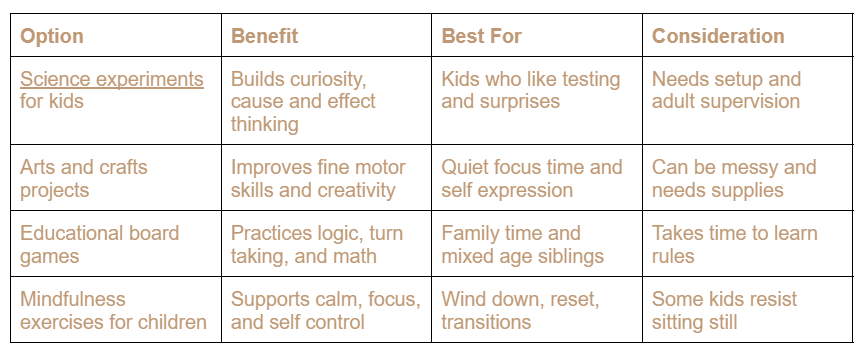
If energy is high, experiments or games can channel it into structured action. If attention is scattered, crafts or mindfulness can slow the pace and rebuild focus. Choose the option that feels easiest to start, and you’ll be surprised how quickly engagement follows.
Habits That Keep Indoor Learning Fun All Week
When indoor learning becomes a predictable rhythm, kids settle faster and you spend less energy negotiating. These small habits create consistency without turning your home into a classroom.
Two-Minute Activity Pick
What it is: Choose one activity from a short list and start immediately.
How often: Daily
Why it helps: Quick starts reduce stalling and build a “we do this” mindset.
Rotate Activity Bins
What it is: Keep 3 labeled bins and swap one each week.
How often: Weekly
Why it helps: Novelty stays high without buying new supplies.
Predictable Start and Stop Cues
What it is: Use a timer and a simple closing phrase like “show me your favorite part.”
How often: Every session
Why it helps: Clear boundaries prevent burnout and reduce arguments.
One Skill, Three Ways
What it is: Practice the same skill via crafts, games, and a mini experiment.
How often: 2 to 3 times weekly
Why it helps: Variety strengthens learning and keeps attention longer.
Turn One Indoor Activity Into Lasting Learning and Connection
Indoor days can feel like a tug-of-war between keeping kids busy and keeping learning meaningful. The steady approach is simple: lean on motivating parental involvement, choose balanced fun and education, and use small routines that make indoor learning encouragement feel normal, not like a battle. With that mindset, positive child outcomes show up in real time: longer focus, fewer power struggles, and more pride in trying. One simple activity done with attention beats a perfect plan done rarely.
Looking to hire a nanny in Cincinnati, Cleveland or on the East Coast?
If you're searching for a trusted nanny service, Hunny Nanny Agency specializes in connecting families with professional, experienced nannies who are carefully screened for safety, experience, and long-term fit.
Our nanny placement services include:
✓ Full-time nanny placements
✓ Part-time nanny placements
✓ Temporary and backup childcare
✓ Family assistants and household support
Interested in hiring a nanny through a professional nanny service? Hire a nanny with Hunny Nanny Agency today.
