
How Stay-at-Home Parents Can Start FlexibleService Businesses from Home

For stay-at-home parents exploring entrepreneurship, the biggest hurdle is rarely motivation, it’s the daily reality of unpredictable schedules, interrupted focus, and the pressure to keep family needs first. Non-ecommerce small businesses can be a strong fit because they rely on skills, relationships, and repeatable services rather than inventory, shipping, or constant online selling. The opportunity is real: practical home-based business opportunities exist in many fields where results matter more than a storefront. The tension is just as real, since work-life balance challenges can turn a promising idea into a source of stress without the right boundaries. With the right flexible business models, a home-based service can scale up or down as family life changes.
Service Businesses You Can Start From Home
If your work has to flex around naps, school pickup, and the occasional sick day, services are often easier to start than product-based businesses. The goal is to pick something you can deliver in small, repeatable blocks, and that you can pause and restart without disrupting family life.
Start with tutoring services you can run in 30–60 minute blocks: Choose one grade level or test and one “quick win” outcome (reading fluency, math homework help, basic study skills). Offer two formats: live sessions during school hours and a limited number of after-dinner slots. To start today, outline a 4-session package with a simple intake form so you’re not reinventing the plan for every student.
Build a pet care business around predictable routes: If you can leave the house, offer midday dog walks, drop-in visits, or pet-sitting for families who travel. Batch your schedule by neighborhood and set clear service windows (for example, 11:00–2:00 for walks) so childcare coverage is easier. Add a safety checklist, leash rules, emergency contact, feeding instructions, to reduce risk and build trust.
Offer writing and translation services with tight deliverables: Specialize in outputs that are easy to scope, like a 600-word blog post, a two-page resume rewrite, or translating a short brochure. Use a “one revision included” policy and a standard questionnaire so projects don’t balloon. If your availability changes week to week, sell capacity in small sprints, two articles per week or five pages translated, rather than open-ended retainer promises.
Package virtual assistant roles into weekly support tiers: Instead of “I can do anything,” create 2–3 bundles such as inbox + calendar cleanup, customer follow-up, or basic admin reporting. This keeps boundaries clear and helps clients understand what they’re buying, especially when your hours are limited. The projected USD 43.4 billion by 2035 growth estimate for VA services suggests demand can be strong for reliable remote support.
Run personal training at home with safety-first options: Offer one-on-one sessions in your garage, backyard, or living room, plus remote coaching for clients who prefer privacy. Start with a short screening and a beginner program focused on mobility, core strength, and consistency, then progress clients in four-week blocks. To stay flexible, reserve two “floating” slots each week for reschedules.
Teach music and art lessons using a simple curriculum ladder: Pick one instrument or medium and create a 6–8 lesson pathway (foundations, technique, a small performance/piece, recap). Offer a sibling discount or small-group lessons during after-school hours to increase hourly earnings without adding commute time. Keep setup minimal: a consistent lesson space, clear practice expectations, and a no-show policy.
Turn bookkeeping into a client-ready, detail-focused plan: If you like routines and accuracy, define a narrow target (solo professionals, local trades, creatives) and a repeatable monthly workflow, organize transactions, categorize, reconcile, and send a short summary. Build credibility with basics like a service agreement, turnaround time, and documentation checklist, then create a business plan that maps your pricing, capacity, and first three outreach moves, grounded in a clear bookkeeping business model.
Launch a Home-Based Service Business Step by Step
This process helps you set up a simple, legitimate service business you can run from home without needing inventory or complicated systems. It matters because the right basics upfront save you time, reduce stress, and make it easier to attract steady clients with the hours you actually have.
Choose one service and define your “minimum offer.” Start with a single service you can deliver in a repeatable block and write a one-sentence outcome (what the client gets, by when). Add clear boundaries: what’s included, how many revisions or sessions, and your standard turnaround time. A tight offer prevents scope creep and makes pricing and scheduling much easier.
Pick a funding option that protects your household. List your startup needs (basic software, insurance, a background check, a website, supplies) and total them, then decide what you can self-fund without creating financial pressure. If you need extra runway, compare a small personal savings plan, a low-interest credit option, or a small business microloan, and commit to a monthly break-even target so you know what “working” looks like.
Select a business structure and separate your money. Choose how you want the business to be legally recognized, since a business structure affects taxes, paperwork, and how you present yourself to clients. Then open a separate business checking account and set a simple system for tracking income and expenses from day one. Even a basic spreadsheet works at the start, as long as it is consistent.
Set up a home office that supports short, focused work sprints.Pick one dedicated spot and set it up for fast start and fast stop: a laptop, a headset, good lighting, and a place to store client notes securely. Create two “default work blocks” each day (even 30 minutes) and a backup plan for childcare gaps, like rescheduling rules or a limited number of weekly flex slots.
Use simple client-acquisition systems built for services.Start with three channels you can maintain: a one-page website, a local or niche community (online group or in-person), and direct outreach to warm contacts who already trust you. Prioritize clarity over volume, since many small business owners prioritize their website’s performance and visitors decide quickly whether you seem credible. Track what works for two weeks, then double down on the best channel instead of adding more.
Business Setup and Marketing Options Compared
To make your home-based service business sustainable, you need two choices to fit your real life: how you will operate legally, and how you will find clients consistently. The table below compares common structures and promotion methods so you can pick an approach that matches your risk comfort, bandwidth, and goals.
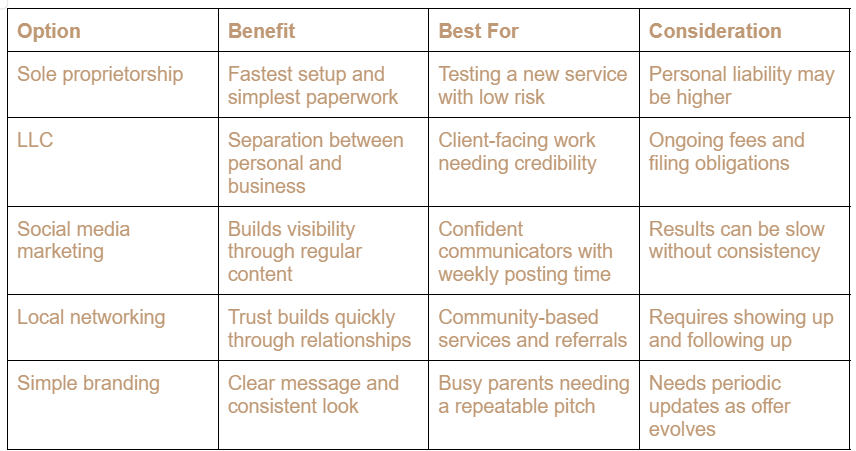
If you want speed and simplicity, start lean and formalize as you gain traction; if you want protection and polish, prioritize structure earlier. For marketing, choose the channel you can sustain for months, not days. Knowing what fits now makes the next step feel manageable.
Questions Parents Ask Before Starting From Home
Q: What licenses or permits do I need for a home-based service business?
A: Start with your city or county business license rules, then check zoning or home-occupation guidelines if clients will visit your home. Some services also require professional licenses or certifications, so verify your specific category before taking payment. When in doubt, call your local clerk’s office and ask what applies to a business run from a residence.
Q: How do taxes work when I run a business from home?
A: Plan to set aside money for self-employment taxes and income taxes, since nothing is withheld automatically. Track income and expenses weekly and keep digital receipts so you can see profit clearly. If you use part of your home regularly and exclusively for work, ask a tax pro whether a home-office deduction fits your situation.
Q: How can I manage time when my schedule changes daily?
A: Build your offer around “service windows,” like two mornings a week or evenings only, and put those boundaries in writing. Use a simple booking tool and require 24-hour notice for changes to protect family time. One focused work block is often more effective than trying to be available all day.
Q: How do I get clients without posting constantly on social media?
A: Pick one repeatable channel and commit to it for 8 to 12 weeks, such as referrals, community groups, or a single local partnership. A short message that explains who you help, what problem you solve, and how to book is usually enough to start. Remember that new business applications keep climbing, so consistency matters more than perfection.
Q: What customer service habits help me stand out fast?
A: Reply quickly, confirm details in writing, and set expectations on timeline, pricing, and what you need from the client. A simple “next steps” checklist after every booking reduces confusion and cuts down on back-and-forth. Many companies are improving customer experience because it drives repeat work, and small service businesses can win here quickly.
Turn One Home-Based Service Idea Into a 48-Hour Start Plan
Balancing family responsibilities with the pressure to earn income can make starting a business feel risky and endlessly complicated. The steadier path is the approach outlined here: choose a flexible service that fits real-life constraints, keep the basics simple, and make decisions that support sustaining home-based business growth. When key business takeaways become a routine, clear offers, realistic time boundaries, and dependable client care, entrepreneurial motivation turns into momentum and confidence building for entrepreneurs follows. Pick one service, take one small step, and repeat it consistently.
Ready to Get Started?

One of the biggest hurdles for stay-at-home parents building a business is the "childcare gap" mentioned throughout this piece, those stretches when you need focused, uninterrupted work time but your kids still need care. Having dependable childcare in place removes that friction and lets you show up for client calls, finish a project, or take on more bookings without the constant juggle. Hunny Nanny Agency can help you build that reliable coverage, so you can grow your new business with confidence instead of stress.
